Free sample · No login

Free AAS practice sample

Try 9 questions across:

  • General Reasoning and Problem Solving
  • Reading Comprehension
  • Mathematics
Start sample

General Reasoning and Problem Solving

Question 1

All vens are silver. No silver object is light.

Which statement must be true?

  1. No ven is light.
  2. Every light object is a ven.
  3. Some silver objects are light.
  4. Every silver object is a ven.
Show answer
A. No ven is light. Correct answer

Every ven belongs to the silver group, and the silver group contains no light objects. Therefore, no ven can be light.

General Reasoning and Problem Solving

Question 2

A gate can open only when both lamps are off. Which situation is ruled out by this rule?

  1. Both lamps are off and the gate stays closed.
  2. One lamp is on and the gate stays closed.
  3. Both lamps are off and the gate opens.
  4. One lamp is on and the gate opens.
Need a hint?

Separate a condition that is required from a condition that guarantees an action.

Show answer
D. One lamp is on and the gate opens. Correct answer

Both lamps being off is required for the gate to open. If even one lamp is on, it cannot open. The rule allows the gate to stay closed when both lamps are off; it does not say that switching them off must open it.

General Reasoning and Problem Solving

Question 3

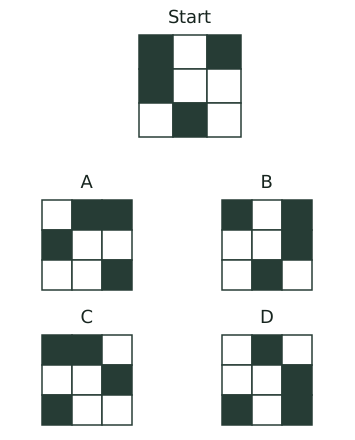
Turn the starting grid one quarter-turn clockwise. Then reflect the turned grid in a vertical mirror line, so its left and right sides swap. Which option shows the result? Move every filled square with the grid.

All are 3 by 3 grids. Rows are counted top to bottom; columns left to right. Filled cells in the starting grid: row 1 columns 1 and 3; row 2 column 1; row 3 column 2. Option A: row 1 columns 2 and 3; row 2 column 1; row 3 column 3. Option B: row 1 columns 1 and 3; row 2 column 3; row 3 column 2. Option C: row 1 columns 1 and 2; row 2 column 3; row 3 column 1. Option D: row 1 column 2; row 2 column 3; row 3 columns 1 and 3.
  1. Option A
  2. Option B
  3. Option C
  4. Option D
Need a hint?

Follow one filled corner through the turn and the mirror, then check the other filled squares.

Show answer
C. Option C Correct answer

Track each filled square through both moves. A quarter-turn clockwise sends (row, column) to (column, 4 − row). Swapping left and right then sends it to (column, row). The final filled cells are row 1 columns 1 and 2; row 2 column 3; and row 3 column 1. Only Option C has those four cells.

Out of the frame

Sana had borrowed a camera for a display called Our Town. She knew exactly what she wanted: the clock tower filling the picture, with no stalls, signs or people around it. From the far corner of the square, the tower looked as if it stood alone. She arrived early, before the market opened, and set the camera on a low wall.

Before she could press the button, a delivery van stopped between her and the tower. The driver began carrying trays into the bakery. Sana waited. She had checked the camera battery, chosen her place and planned the time, yet now her careful plan had come unstitched. She could move nearer the tower, but from there its top would disappear beyond the edge of her picture. She put the camera strap around her wrist and walked towards the bakery instead.

In the dark shop window, the clock tower appeared again. Its reflection leaned slightly, and one corner was hidden by a white handprint on the glass. Inside, the baker was pressing dough with flour-covered hands. He looked up and came to the doorway. Sana pointed to her camera, then to the handprint and the tower behind her. He nodded and stepped aside.

She took one photograph, then another with the baker’s hand resting on the outside window ledge. “This is usually the part I wash off,” he said, laughing at the flour on his fingers. He held them still while she checked the screen. The clock face was smaller than she had intended, but the pale hand was sharp and clear. Sana did not crop it out. When the van finally moved, she could have returned to her first position. Instead, she thanked the baker and went home with the camera still hanging from her wrist.

Reading Comprehension

Question 4

Why does Sana first choose the far corner of the square?

Answers and explanations appear after this group.

  1. It lets her show the tower without the busy surroundings.
  2. It lets her include the market stalls beside the tower.
  3. It lets her photograph the baker working through the window.
  4. It lets her make the tower’s top disappear from the picture.
Need a hint?

Look at Sana’s plan before the van arrives.

Reading Comprehension

Question 5

What does “her careful plan had come unstitched” suggest?

Answers and explanations appear after this group.

  1. Sana has lost the instructions for using the camera.
  2. Sana has completed the photograph exactly as planned.
  3. The situation no longer fits the plan Sana prepared.
  4. The route Sana took to the square is now blocked.
Need a hint?

Read what happened immediately before this expression.

Reading Comprehension

Question 6

How does the baker seem to feel about the flour appearing in the photograph?

Answers and explanations appear after this group.

  1. Slightly worried that it will make the picture untidy.
  2. Lightly amused that it has become part of the picture.
  3. Rather puzzled about why Sana has come to the bakery.
  4. Quietly annoyed that Sana has changed her original plan.
Need a hint?

Use both his remark and his actions immediately around it.

Check answers
  1. Question 4

    Why does Sana first choose the far corner of the square?

    A. It lets her show the tower without the busy surroundings. Correct answer
    B. It lets her include the market stalls beside the tower.
    C. It lets her photograph the baker working through the window.
    D. It lets her make the tower’s top disappear from the picture.

    Sana wants the clock tower to fill the picture without stalls, signs or people. From the far corner it appears to stand alone. The bakery-window photograph comes later, after her original view is blocked.

  2. Question 5

    What does “her careful plan had come unstitched” suggest?

    A. Sana has lost the instructions for using the camera.
    B. Sana has completed the photograph exactly as planned.
    C. The situation no longer fits the plan Sana prepared. Correct answer
    D. The route Sana took to the square is now blocked.

    Sana has prepared the battery, position and timing, but the van blocks the view she planned to photograph. “Come unstitched” suggests that the parts of her plan are no longer holding together. It describes the disrupted plan, not a broken camera, completed task or blocked journey to the square.

  3. Question 6

    How does the baker seem to feel about the flour appearing in the photograph?

    A. Slightly worried that it will make the picture untidy.
    B. Lightly amused that it has become part of the picture. Correct answer
    C. Rather puzzled about why Sana has come to the bakery.
    D. Quietly annoyed that Sana has changed her original plan.

    The baker laughs at the flour on his fingers and holds them still while Sana checks the photograph. The contrast between normally washing off flour and now keeping it in a picture gently amuses him. His cooperation supports amusement rather than worry, puzzlement or annoyance.

Mathematics

Question 7

On a map, 1 centimetre represents 3 kilometres. A route measures 4.5 centimetres on the map. A road closure adds a further 1.5 kilometres to the real route.

What is the new route length?

  1. 6 kilometres
  2. 13.5 kilometres
  3. 15 kilometres
  4. 18 kilometres
Show answer
C. 15 kilometres Correct answer

The original route is 4.5 × 3 = 13.5 kilometres. The closure adds 1.5 kilometres in the real world, so the new length is 13.5 + 1.5 = 15 kilometres.

Mathematics

Question 8

A recipe uses 240 grams of flour to make 8 rolls. Mia has 420 grams of flour but keeps 60 grams for another recipe. At the same rate, how many rolls can she make with the flour she uses?

  1. 8
  2. 12
  3. 14
  4. 15
Show answer
B. 12 Correct answer

Mia uses 420 − 60 = 360 grams. The recipe uses 240 ÷ 8 = 30 grams per roll. Therefore, 360 ÷ 30 = 12 rolls.

Mathematics

Question 9

A display has 35 cards, numbered 1 to 35, with each number used once. All cards whose numbers are multiples of 3 or multiples of 5 are removed, including cards that meet both rules. How many cards remain?

  1. 17
  2. 24
  3. 19
  4. 28
Need a hint?

Which cards belong to both removal groups? Do not count those cards twice.

Show answer
C. 19 Correct answer

There are 11 multiples of 3 from 1 to 35 and 7 multiples of 5. Cards 15 and 30 are in both groups, so adding 11 and 7 counts each of those cards twice. The number removed is 11 + 7 − 2 = 16. Therefore 35 − 16 = 19 cards remain. You could also list the removed numbers and count each only once.